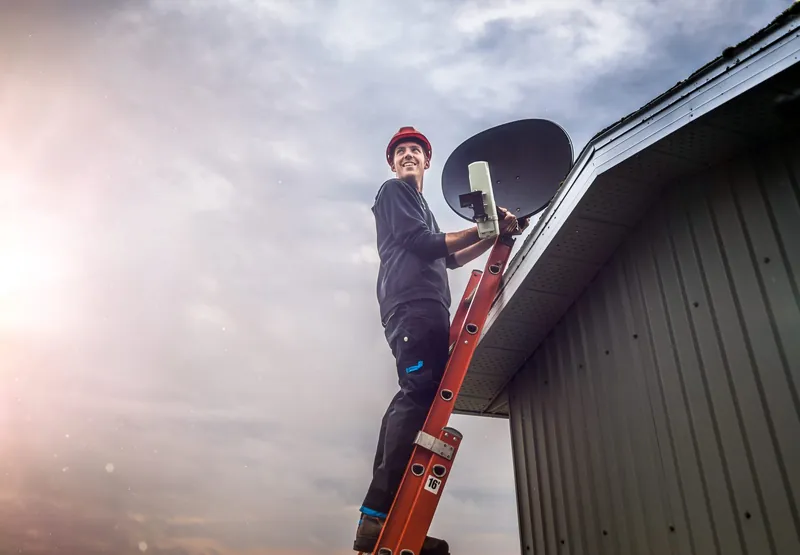
DStv cable repairs come up often because the cable is the part of a satellite installation most exposed to sun, water, pets and everyday wear. A dish can be perfectly aligned and the LNB brand new, yet a single corroded connector or crushed section of cable can still cause pixelation, drop-outs or a full no-signal message. OnspotElec traces cabling faults across Gauteng and either re-terminates the damaged ends or replaces the run.
Where DStv Cables Usually Fail
Satellite TV uses coaxial cable, most commonly RG6, joined to equipment with screw-on F-connectors. Each of the problems below weakens the signal travelling from the LNB to the decoder.
Water at the connectors
Water is the main enemy. An unsealed connector at the LNB lets moisture creep in, and it can then travel along the cable's braided shield. You'll often see green or black discolouration on the copper when the connector is cut back.
Sun-perished outer sheath
Years of UV exposure make the outer jacket brittle until it cracks, letting water reach the shield. Cable running across a roof or along a north-facing wall is most at risk.
Rodents and pets
Rats in the roof space and dogs in the garden both chew cable. Even a partial bite that leaves the cable looking intact can damage the shield inside.
Pinches, kinks and tight staples
Cable shut in a door or window frame, bent sharply around a corner or hammered flat by staples has its internal shape crushed. Coax relies on the centre conductor staying evenly spaced inside the cable, so a crushed point loses signal.
Damaged wall plates and cheap connectors
A wall plate pulled out of the wall, or a cable yanked when a TV cabinet moves, can loosen the termination behind it. Twist-on connectors without proper compression are another frequent cause of weak signal, because they loosen and let water in.
If you'd like to check for visible damage yourself first, our guide on identifying damaged cables and connectors shows what to look for from the ground and behind the TV. For anything on the roof, call 083 489 1322 rather than climbing up.
More than one TVSplitters, Long Runs and Signal Loss
Every metre of coaxial cable loses a little signal. On a short run that hardly matters, but long runs, extra joints and thin or poor-quality cable add up until the decoder is working with too little. On very long runs, amplification may be needed, which is one reason a cable job is quoted on the actual layout.
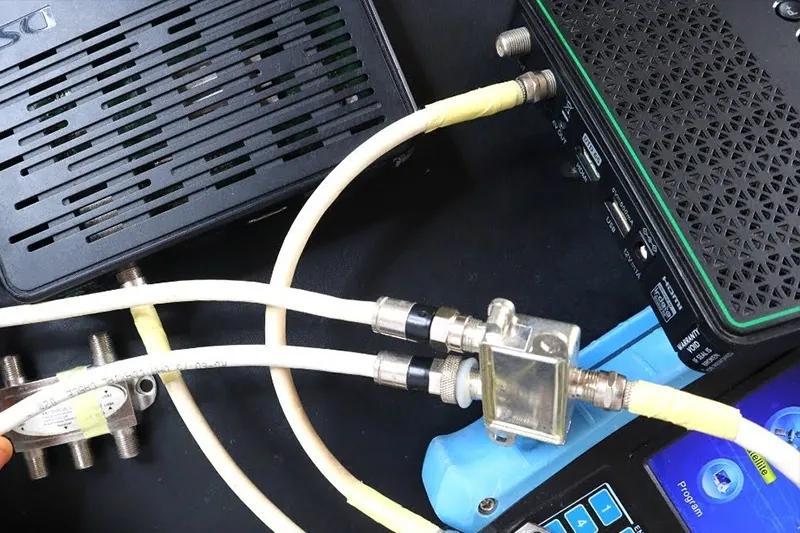
Splitters cause a different problem. A basic splitter divides one feed between two outputs, but on a satellite system each decoder needs to control what the LNB sends down its cable. When two decoders share a single LNB output through a splitter, one can interfere with the other's channel changes, and every split also reduces the signal.
Proper distribution means giving each decoder, or each tuner, its own feed:
- Separate LNB outputs. A twin or quad LNB with its own cable to each decoder.
- DStv Smart LNB. Recommended by DStv for Explora and most XtraView installations, using UniCable connections; see XtraView setup.
- Multiswitch distribution. The usual approach in complexes, apartment blocks and commercial buildings, fed from a shared dish.
Our article on signal distribution for multiple viewing points explains these options in more detail.
Re-Terminate or Replace the Whole Run?
Not every cable fault means new cable. The table below shows how we usually decide, though the final call depends on what testing shows.
| What we find | Usual fix | Why |
|---|---|---|
| Corrosion only at the connector end, sheath in good condition | Cut back and fit a new F-connector | The damage is limited to the termination |
| Water has travelled along the cable | Replace the run | Moisture in the shield can't be removed by trimming a short length |
| Sheath cracked by the sun over a long stretch | Replace the run | More water will get in wherever the jacket has failed |
| One chewed or crushed section | Usually replace the run | A joint adds another point where water and signal loss can creep in |
| Old, thin or unsuitable cable on a long route | Replace with RG6 | Less signal loss over distance |
| Loose wall plate, cable sound | Refit or replace the plate | The cable itself doesn't need replacing |
When cable is replaced, it's routed as neatly as the building allows: through the roof space, inside conduit where it's exposed outdoors, clipped rather than stapled flat, and with a small loop below outdoor connectors so rainwater drips off before reaching them. Complex rules about visible cabling are taken into account. We do cable repairs for properties across Gauteng, including Alberton, Edenvale and Krugersdorp.
Cable Repair FAQs
Tape may hold for a short while, but it doesn't keep water out for long, and it does nothing for a crushed or chewed shield. Replacing the damaged run is the lasting fix.
RG6 coaxial cable with properly fitted F-connectors, which is the common standard for satellite TV. Outdoor connections are weatherproofed.
Usually, at least partly. Routing through the roof space and down inside walls or conduit is often possible, but it depends on the building's construction and, in complexes, the body corporate or HOA rules.
Only if the cable or connectors are the cause. Rain drop-outs can also come from a misaligned dish or a failing LNB, so the whole system is tested first. If the fault is elsewhere, see no signal and E48-32 assistance.