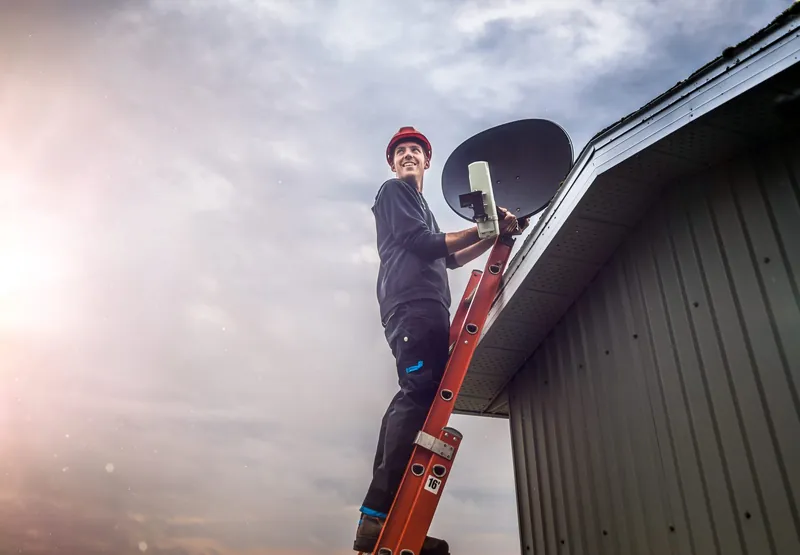
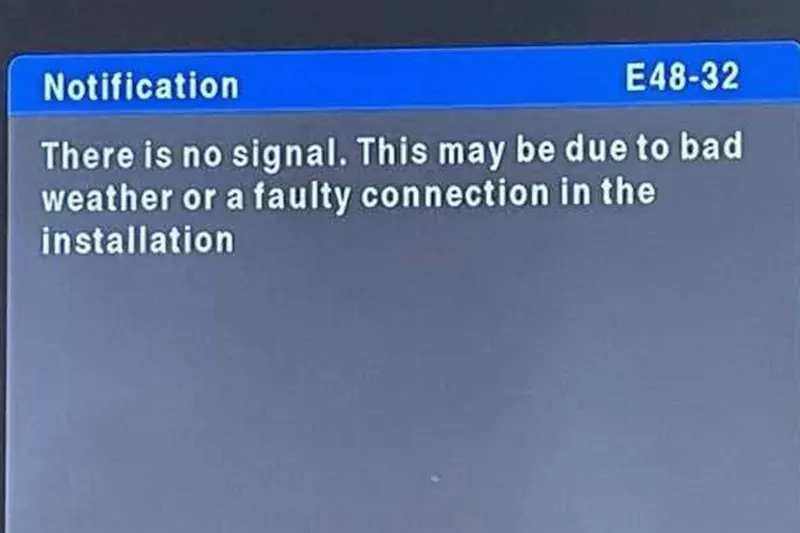
A DStv no signal message is frustrating, especially when it appears out of nowhere in the middle of a match. The E48-32 notification reads along the lines of "There is no signal. This may be due to bad weather or a faulty connection in the installation." In plain terms, the decoder isn't getting a usable signal from the satellite. OnspotElec helps households and businesses across Gauteng find and fix the cause, and we're open 24 hours, every day.
What E48-32 Tells You, and What It Doesn't
E48-32 is a symptom, not a diagnosis. The decoder can only report that the signal is missing or too weak; it can't tell where along the line the signal was lost. The same message can come from any of these:
- Heavy rain or storm cloud. Called rain fade, this is temporary and clears once the worst of the storm moves on.
- Connector trouble. Loose, corroded or water-damaged F-connectors at the dish, the wall plate or the decoder.
- Damaged cable. Coaxial cable that has been chewed, crushed, kinked or perished by the sun.
- A dish knocked off target. Wind, hail, a ladder or roof work can shift it far enough to lose the satellite completely.
- A failed LNB. The unit on the dish arm can fail through age, water ingress or storm damage.
- A faulty switch, splitter or multiswitch. Relevant in homes with more than one decoder and in shared buildings.
- Blocked line of sight. A tree that has grown, or a new building or extension, in the north-easterly direction the dish faces.
- A decoder tuner fault. Less common, but possible when everything upstream tests fine.
For more background on the message itself, read our guide to the E48-32 error. For a broader look at outages, see common reasons for no-signal problems.
Before you callSafe Checks You Can Do Yourself
These take a few minutes and need no tools or ladders. They sometimes solve the problem, and even when they don't, the answers help a technician narrow it down.
- Look at the weather. If a heavy storm is overhead, wait for it to pass. Signal normally comes back once the heaviest rain moves away.
- Check every TV. If you have more than one decoder, see whether all of them show no signal or just one. All of them points towards the dish, LNB or main cable; only one points towards that decoder's own cable or connection.
- Check the cable at the decoder. Make sure the coaxial cable is screwed firmly into the decoder's LNB or satellite input. Don't force it or bend the thin centre pin.
- Restart the decoder at the wall. Switch off at the plug, wait a little, switch back on and give the decoder time to start up fully.
- Look at the dish from the ground. Check for anything obvious: a dish pointing the wrong way, a bent reflector, a dangling LNB, a loose cable or a branch in front of it.
Don't climb onto the roof, stand on a ladder near the dish, or open the decoder, LNB or power supply, and keep well away from overhead power lines. If these checks don't bring the signal back, call 083 489 1322.
Storm Outage or Genuine Fault?
| Clue | Points to weather | Points to a fault |
|---|---|---|
| When it happens | During a heavy downpour or under dark storm cloud | In clear weather, or it carries on after the rain stops |
| How long it lasts | Returns once the heaviest rain passes | Stays off, or comes and goes for days |
| Which channels | Everything drops together and returns together | Some channels work and others don't, even in fine weather |
| Pattern over time | Only in the very worst storms | Worse with every storm, or since roof work, wind or hail |
Gauteng's summer thunderstorms, roughly from October to March, regularly cause short outages. A properly aligned dish with sound, weatherproofed connectors rides out more of them, so an installation that drops out at the first few drops of rain usually needs realignment or connector work rather than more patience.
How a Technician Traces a No-Signal Fault
The technician follows the signal path backwards, from the decoder towards the sky, testing at each point. That way the fault is found rather than guessed at.
Decoder
Signal readings are checked on the decoder and, where needed, a meter is connected at its input to confirm whether any signal is arriving.
Cable and connectors
Each connector is inspected and the cable run tested for water, corrosion or damage. Faulty runs can be re-terminated or replaced.
Switch, splitter or multiswitch
If the setup has one, its inputs and outputs are tested to see whether it is passing the signal through properly.
LNB
The LNB is tested at the dish. One that has failed or taken in water is replaced, as described on our LNB replacement page.
Dish and line of sight
The dish and mount are checked for damage and movement, the signal is peaked again, and the view towards the satellite is checked for new obstructions.
Once the cause is clear, you're told what's needed and given a quote for the actual work. Emergency DStv assistance is available around the clock, but scheduling depends on your location, the fault and technician availability, so please call to check; our emergency DStv repairs page explains how urgent requests work. We help customers throughout Gauteng, including Germiston and Roodepoort.
E48-32 Questions
Channels are spread across different transponders. When the signal is borderline, the stronger ones still get through and the weaker ones fail. That pattern usually means the dish needs realigning or a component is starting to fail.
No. E48-32 is about signal reaching the decoder. Subscription or payment problems usually show different messages, such as the commonly reported E16-4, and those are handled by DStv rather than an installer.
Give it until the heaviest rain has passed. If the sky has cleared and the message is still there after a restart, the outage isn't just weather and it's worth calling.
Yes, a tuner fault inside the decoder can, though it's less common than cable, connector, LNB or dish problems. A technician rules those out first. If the decoder is at fault, it goes through DStv's repair or replacement channels or is replaced.